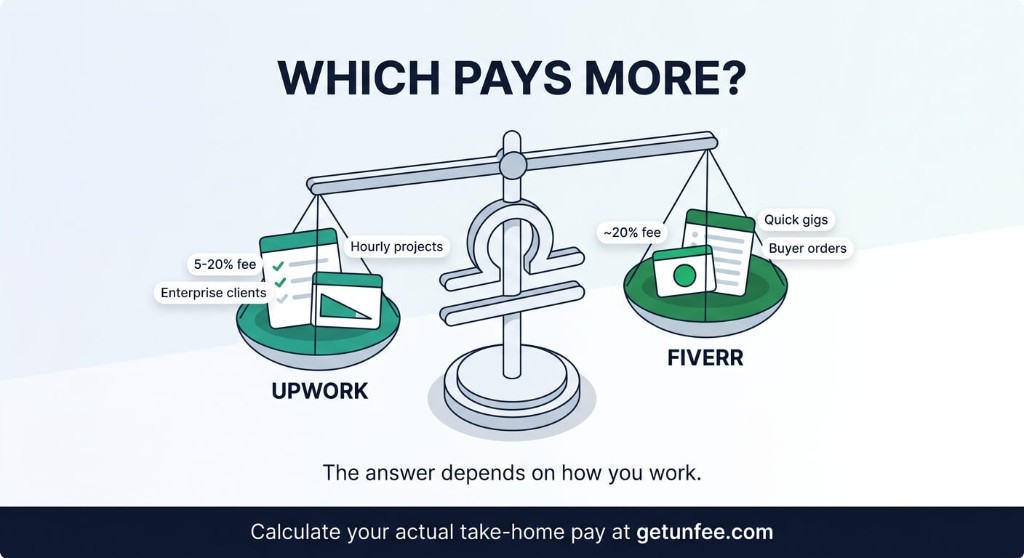
Upwork vs Fiverr: Which Platform Pays More in 2026?
Last updated: March 24, 2026
A side-by-side comparison of the two largest freelance marketplaces — fee structures, real net income scenarios, and which platform makes financial sense for your work style.
Upwork Fee
5% – 20%
Sliding scale per client
Fiverr Fee
20% flat
Every order, no discounts
Fee Structures at a Glance
Upwork uses a sliding scale that rewards long-term client relationships: 20% on the first $500 billed to a client, 10% from $500.01 to $10,000, and 5% on everything above $10,000 with that same client. Fiverr charges a flat 20% on every order — whether it is your first gig or your hundredth with the same buyer.
On paper, both platforms look expensive for new clients. The difference shows up when projects grow in size or when you retain clients over months and years.
Net Income Comparison (Platform Fee Only)
These examples assume a new client on Upwork (worst-case fee scenario). Withdrawal, FX, and tax costs are not included — use the calculator below for your full picture.
| Gross Invoice | Upwork Fee | You Keep (Upwork) | Fiverr Fee | You Keep (Fiverr) | Winner |
|---|---|---|---|---|---|
| $500 | $100 (20%) | $400 | $100 (20%) | $400 | Tie |
| $2,000 | $250 | $1,750 | $400 (20%) | $1,600 | Upwork (+$150) |
| $10,000 | $1,050 | $8,950 | $2,000 (20%) | $8,000 | Upwork (+$950) |
Gross: $500
Upwork
$400
Fiverr
$400
Tie
Gross: $2,000
Upwork
$1,750
Fiverr
$1,600
Upwork (+$150)
Gross: $10,000
Upwork
$8,950
Fiverr
$8,000
Upwork (+$950)
When Upwork Pays More
- Large or recurring projects — the sliding scale drops to 10% and then 5% as you bill more to the same client.
- Long-term retainers — a $3,000/month client quickly moves you into lower fee tiers.
- Hourly and custom contracts — better fit for ongoing work where scope expands over time.
- Enterprise clients — higher budgets mean the 5% tier becomes realistic within a single engagement.
When Fiverr Makes More Sense
- Packaged, productized gigs — you sell fixed deliverables at prices you control upfront.
- Built-in buyer traffic — Fiverr's search engine brings clients to you without proposals or Connects.
- High-volume, low-touch orders — if your workflow is streamlined, the flat 20% is predictable and easy to price in.
- Creative niches — design, video, voice-over, and writing gigs with clear scopes perform well in Fiverr's marketplace.
Beyond Platform Fees
Platform commission is only the first deduction. Both Upwork and Fiverr payouts pass through withdrawal methods — PayPal, Payoneer, Wise, or direct bank — each with its own fees and FX spreads. A freelancer who saves 5% on Upwork but loses 4% on a bad currency conversion may still end up worse off than a Fiverr seller using Wise.
The only reliable way to compare platforms is to calculate your full net income: platform fee + intermediary fee + bank fee + taxes. That is exactly what UnFee is built for.
Compare Upwork vs Fiverr now
Enter your invoice amount and switch between Upwork and Fiverr to see your exact take-home pay after all fees.
Calculate Fees
You Keep
$0.00
Related guides
- Upwork Fees Explained: How to Maximize Your Income
Understand Upwork's sliding fee structure: 20%, 10%, and 5% tiers. Learn how to maximize your net income and calculate exact take-home pay.
- Fiverr's 20% Fee: Is It Still Worth It in 2026?
Is Fiverr's flat 20% commission still worth it in 2026? A practical guide to fees, margins, and when the platform makes financial sense for freelancers.
- Fixed-Price vs. Hourly Contracts: Which Pays More?
Fixed-price or hourly billing? Compare which freelance contract type pays more after platform fees, scope risk, and your effective hourly rate.